
Dubai Flexible Work 2026: What 24,000 Employees Learned
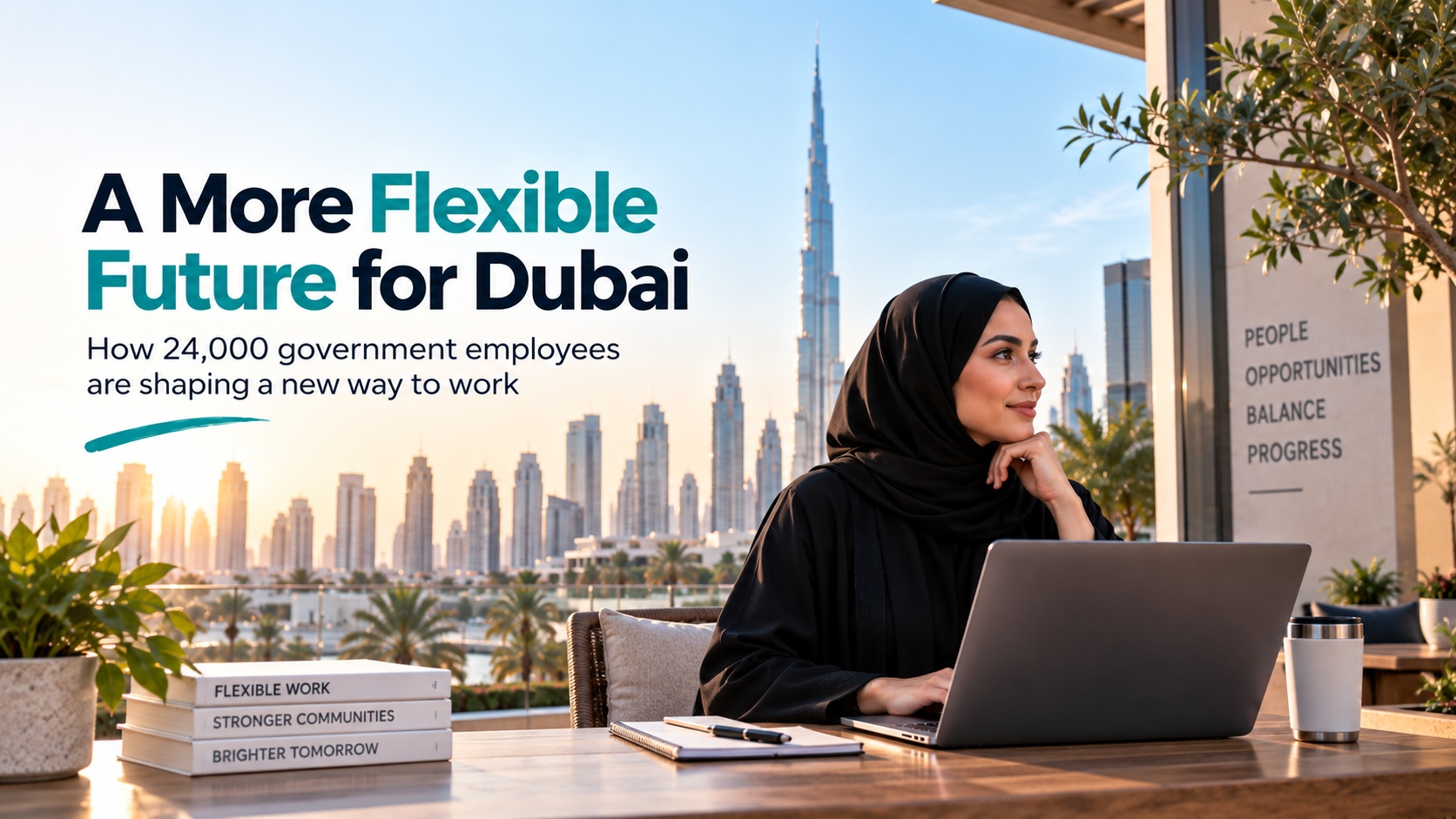
Dubai’s Flexible Summer 2026 involved more than 24,000 government employees. Here’s what the initiative says about flexible work and the UAE’s future workplace.
What happens when flexible work moves beyond theory and is tested across thousands of employees?
Dubai now has a much clearer answer.
The Dubai Government Human Resources Department has concluded Our Flexible Summer 2026, a large-scale initiative designed to test different approaches to working hours while maintaining productivity and government services. The programme ran from 29 June to 10 September 2026 and involved more than 24,000 employees across 49 Dubai Government entities.
Rather than simply asking whether employees prefer flexibility, Dubai used the programme to understand how different working arrangements perform in real organisations.
What Was Different About the Workweek?
Participating government entities were able to use two main working models. Under one model, employees worked seven hours per day from Monday to Thursday and four and a half hours on Friday. Under the second model, employees worked eight hours from Monday to Thursday and had Friday off completely. Government entities could also use approved flexible hours and remote-working arrangements where operational requirements allowed.
The important point is that flexibility was not treated as one fixed rule. Different organisations have different responsibilities, customer needs and working environments. The initiative allowed entities to test arrangements that suited their operations while continuing to deliver services.
Why Did Dubai Run the Programme?
Flexible work is often discussed as an employee benefit. Dubai is looking at it more broadly. The initiative examined the relationship between employee experience, performance efficiency and continuity of services. Dubai Government Human Resources said the wider participation in 2026 created a larger body of practical data that can help shape future workplace policies.
That matters because the future of work is unlikely to be simply “office or remote.” It may increasingly be about matching the right working model to the type of job being performed. Some roles need people physically present every day. Others can be organised around outcomes, shorter working weeks or more flexible schedules.
Flexibility Is Becoming Part of the UAE Work Conversation
The UAE has been experimenting with different approaches to work for several years. Remote work, flexible hours, compressed schedules and digital government services all reflect the same wider shift: work does not always need to happen in exactly the same way it did ten years ago.
For employees, greater flexibility can create more room for family, health, education and personal responsibilities. For organisations, the challenge is ensuring that flexibility does not reduce customer service, collaboration or productivity. Dubai’s approach is interesting because it is trying to measure both sides instead of treating flexibility as automatically good or bad.
Flexible Time Can Also Create New Opportunities
A more flexible schedule can change what people are able to do outside their main working hours. Someone may use additional time to study, develop a professional skill, build a small business or explore another legitimate source of income. That is where platforms such as Taysir Earn can become relevant. People with suitable skills can explore local tasks and flexible opportunities around their existing schedules, subject to applicable UAE employment, visa, licensing and permit requirements.
You can also read One Skill Can Create More Than One Income Stream in the UAE or download the Taysir app to explore available tasks.
Dubai’s latest experiment suggests the future of work may not only be about where we work. It may also be about having greater control over when and how we use our time.